Waitotara
Taranaki, North Island
2010 Ajr

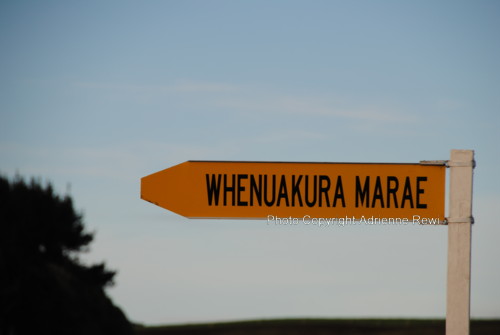
 The sun was just rising when I stopped across the road from the Whenuakura Marae, north of Waverley and south of Patea in South Taranaki, on my way to New Plymouth in May this year. It's a pretty spot, located beside the Whenuakura River against a backdrop of classically green Taranaki hills and a thicket of gum trees. There were dewy tracks through the grass that morning, the doors were open and the caretaker's lawn mower was parked ready for action; but there wasn't a soul about, so I drove on. I've since discovered that the marae is home to the Kaikurakau and Pomotangi hapu of Ngaa Rauru Kiitahi - www.ngarauru.org.nz
 As I left Whanganui recently, driving northwest to New Plymouth on the Surf Highway, I came upon this unusually picket-fenced marae down a side road. It's Waiokura Marae, located on Winks Road, just south of the small town of Manaia, which was settled in the 1880s and named after Chief Manaia Hukunui. The whare here - Paraukau - was built in his honour. It's home to the people of Ngati Tu, a hapu of Nga Ruahine. All was quiet the morning I arrived - but for the early chattering and tinkering at the nearby Kohaga Reo - a peaceful scene, with the metal road snaking away into the rolling green and Mt Taranaki looming protectively on the horizon.

 It was a different story a short distance away on the main highway opposite the Manaia Golf Course, where these signs indicate Ngati Tu dissatisfaction over their unresolved land claims.

 It was a cold, grey, wet morning just on daylight when I came to a stop outside Urenui Marae, north of New Plymouth last week. I'm lucky these photos came out at all as it was pouring with rain and large trucks were rushing by, splashing me as they went. But in hindsight, I'm pleased I stopped on the roadside, as Urenui is a special place for Ngati Mutunga - it is their only remaining marae and has been a focal point for Ngati Mutunga activities and gatherings since the 1870s. It's fair to say it's the cultural heart of Ngati Mutunga. I love the way their three taonga - the ancestral houses of Mahi Tamariki, Te Aroha (both wharenui) and Te Titohea (wharekai), take command of the small hillock above the main highway. www.ngatimutunga.iwi.nz
  Another in the Series Meet the People – Contemporary Maori Doing Ordinary and Extraordinary Things – Jo Tito (Taranaki, Ngati Pikiao Tuhourangi-Ngati Wahiao), grew up in the small village of Waipa, 5km south of Rotorua and now lives in Gisborne with her partner, Todd (Taranaki, Te Ati-Haunui-a-Paparangi) and two of his children. Both are fluent Maori speakers. “I learned a little Maori while I was at school – maybe an hour a week – but it wasn’t until I experienced total immersion back home in Taranaki that I became fluent. It’s definitely the best way to learn,” she says. Jo is very much driven by her passion for Maori language. It is at the root of everything she does – including in her work as an artist and photographer. “I am inspired by the patterns of nature as my ancestors were, but my work is not solely based on Maori culture. The spiral for instance, appears in my work regularly and while it is a common Maori design element, it is also seen in many other cultures. But I am very much driven by our Maori language and wherever I can incorporate this into my work I will. It’s a whole different world when your whakaaro, your way of thinking, is in Maori. This inspires me to create.”
xx.jpg)
 "Kohatu (rock)" Painted rock by Jo Tito
 "Whariki (Mat)" Photo by Jo Tito