Showing posts with label Traditional Foods. Show all posts

Tuesday, August 30, 2011

Traditional Kai - Karengo

Karengo is a member of the Porphyra species of edible seaweeds and is eaten throughout the world. It is closely related to Japanese nori and Welsh laver and is highly prized by South Island Māori. It is listed as a Ngāi Tahu taonga in the Ngāi Tahu Claims Settlement Act 1998 and during World War II, dried karengo was sent to the Māori Battalion in the Middle East and soldiers chewed it while they were on the march.

 I visited Onuku marae, near Akaroa recently, where karengo is a seasonal delicacy.
Every spring, between July and september, the locals on the kaik, go down to the rocky shore and gather the brown seasweek off the rocks. A bulk harvest of karengo was traditionally dried in the sun. But if they want to eat it the same day, they pan dry it. To cook it hinu (mutton fat) or butter, is added and it's cooked slowly,  with small amounts of water added over a two hour period. “Karengo is not easy to cook. It’s tough and it takes a long time to make it soft but it’s worth the effort,” the locals say.
The day I visited, they added cream to the cooked karengo mixture for extra richness and flavour and this is placed in the tiny filo cases and set aside.
Eel, or tuna, was also on the menu, along with titi (mutton bird), and both were given a modern twist in sushi.
Many of the Onuku whanai have been going to nearby Te Roto o Wairewa between March and May since hthey were young and they're  familiar with all the old ways of tuna gathering.
“We hook them out of the canals into the pararu and on a good night we’ll get around 200. They’re gutted, washed in the sea and then hung by flax threaded through their gills. With their tails cut off they bleed out; then they’re deboned, salted and dried on hooks in the whata above the beach by the marae. These days the eels are then frozen or smoked and stored ready for use,” they say.

Monday, October 18, 2010

Otakou Marae - A Peninsula Place

Otakou Marae sits almost at the end of Otago Peninsula, near Dunedin - a splendid collection of buildings tucked away down a side road, a short walk from the water's edge. I went there for the first time three or four years ago with Ngai Tahu's TE KARAKA team, working on a series of Ngai Tahu runanga kai features.
I spent the day talking with local kaumatua (elders) about the traditional importance of Otago Harbour as a food source for the Otakou people and in particular, our discussions focussed on the cockle or tuaki as they are known to the locals. Actually New Zealand Littleneck Clams (Austrovenus stutchburyi), they are the single-most abundant large invertebrate animal found in inter-tidal sand flats in sheltered harbours and estuaries throughout New Zealand.


Tuaki have been an important food source for Muaupoko (Otago Peninsula) Maori for generations and their shells have commonly been found in centuries-old middens. The whole area was once speckled with many kaik (villages) and Pukekura (Taiaroa Head) was an important fortified pa.

It was a perfect sunny day in May when I visited Otakou again earlier this year and I couldn't help remembering my previous visit, sitting outside on the bench seats listening to Matenga Taiaroa talking about his great-grandfather, who walked the same soil; to Tangi Russell, who feels just as passionate about maintaining the harbour's tuaki resource; and to Paul Karaitiana, who lives just around the corner from the marae at Te Rauone Beach. He's been there thirty years or more and still gathers tuaki and other kai moana (seafood).
Otakou is 'home' to Waitaha, Rapuwai, Kati Hawea and Kati Mamoe; and in my view it's one of the loveliest of the southern Ngai Tahu marae. Quite apart from its divine location, I'm intrigued by its hefty, elaborately embellished church, its carvings and other tucked-away treasures. www.ngaitahu.iwi.nz www.tekaraka.co.nz

Tuesday, August 17, 2010

Spuds!


Maori Potatoes
On Sale
Taupo Market
June 2010. Ajr

Friday, August 13, 2010

To Market, To Market


The Rotorua Farmers' Market at Kuirau Park in Rotorua is somehow 'quintessential Rotorua.' Get down there early on a Saturday morning (in winter in this case) and the geothermal mist is rising, the smell of sulphur hangs in the air and an early guitar is strumming a few warm-up chords.

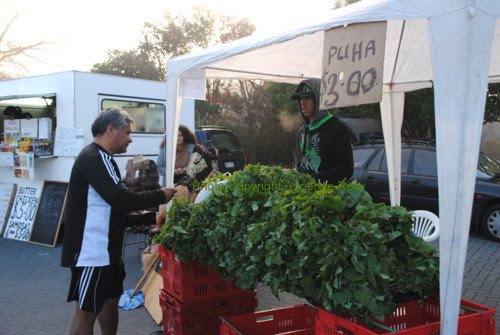
It's not a Maori market per se, but you'll find a wide range of traditional Maori kai favourites - puha, Rewena bread, steamed puddings, fresh kina, whitebait fritters, mussel patties and watercress bundled into big leafy bunches.

There are stalls selling Maori handcrafts (and a few imitations) and on the morning I went, back in June, there was a woman making korowai (cloaks), her fingers seemingly impervious to the cold as she wove feathers into her garment. The market has a wide range of fresh vegetables and a great atmosphere - definitely a must-visit if you're in town on a Saturday morning.

Monday, May 3, 2010

Traditional Kai - Kina

Kina = Sea Urchins
I've never been brave enough to taste kina myself but they are considered a delicacy among many Maori, who dive for them and then eat the yellow interior roe. These prickly beauties were caught off the Kaikoura coast and were eaten at Takahanga Marae during a recent waka wananga.

Monday, April 26, 2010

Paua - Favourite Kaimoana


Paua is the Maori name given to three species of large edible sea snails belonging to the Haliotidae family - known as abalone in the Northern Hemisphere. In New Zealand, the best known of the paua species is Haliotis iris and while it has a beautiful irridescent blue-green shell, in my opinion, the slimy, black 'animal' within would have to be one of the least appetising-looking potential meals I've ever come across.

But looks can be deceiving. Given a thorough bashing to tenderise the flesh and then sliced thinly and barbecued, paua flesh is indeed a delicacy. To Maori, they are a taonga (treasure) and they are sought after both as a food and for their colourful shells, which are often incorporated into carvings (usually to represent eyes) and jewellery. Another favourite way to eat paua is to mince them and make them into fritters. These juicy specimens were caught at Kaikoura and were served at the final meal of the waka wananga I attended recently at Kaikoura's Takahanga Marae.

Saturday, April 10, 2010

Following a Food Trail

I took a walk in Christchurch Botanic Gardens yesterday. I had heard that there was 'an exhibition' of Maori trapping and snaring techniques, organised by the gardes and staged in conjunction with the current (very beautiful) Ngai Tahu exhibition Te Hokinga Mai, which is showing at Canterbury Museum.
I was given the small booklet, Te Wao Nui a Tane - The Great Forest of Tane and sent on my way to explore the gardens.

It took me all of three seconds to realise that the trail had been designed for primary school children and that the activities outlined in the booklet, were all about 'conjuring up' an imagined search for traditional foods. Nonetheless, I wandered about, followed the signs, watched groups of kids looking for eels in the water and generally had a lazy time soaking up the sun. I of course, had been hoping to photograph traps and snares. There were none; but the booklet is a nice little exercise in traditions for children, who may not have learned to identify certain native trees, plants, birds and wildlife. And with it's maps marked with an X, its traditional tracking signs, quizzes and learning tasks, the whole exercise seemed worthwhile to me. www.ngaitahu.iwi.nz

Saturday, January 9, 2010

Down at the Jetty


Man Fishing
At the end of Rapaki Jetty

Discarded Mussel Shells
Signs Of
A Previous Feast

Sunday, December 20, 2009

A Day at the Beach

Digging for Cockles
Otakou Marae
Otago Peninsular, Dunedin

Thursday, December 10, 2009

Titi Territory

When I was at Takutai o te Titi Marae in Colac Bay in Southland a few weeks ago for the Ngai Tahu Hui-a-Tau, I was reminded again of what this pretty place is famous for – Titi, also known as muttonbird. I had visited before a couple of years earlier, with Ngai Tahu chef, Jason Dell and photographer Phil Tumataroa in the course of preparing another of the Te Karaka magazine kai features and despite Jason’s best culinary efforts, I wasn’t won over to the taste of titi. Those who are however, seem to love it with a passion and kaumatua from the Oraka-Aparima Runaka were happy to share their memories of titi gathering, or, as it is known in these circles, birding.
Titi, muttonbird, sooty shearwater, Puffinus griseus – they’re all the same – is a migratory seabird and the young birds caught by Maori as an annual delicacy on the Muttonbird Islands, southwest of Stewart Island, are fat with the oils of the fish eaten and regurgitated by their parents. The parent birds come home every night, having eaten pilchards, shrimps, sprats and small squid and the young birds gobble down their oily dinner and grow very, very fat. It’s no wonder they smell on cooking. Kaumatua, Robin Thomson leaned back in her chair and drew in the kitchen aromas. She remembered her 1940s childhood and the excitement of travelling down to Murderers Cove on Taukihepa Island on the old ferry, Wairua.
“In those days our family had a round, thatched wharerau on the island, with a pit fire in the floor and a hole in the roof to let the smoke out. We’d put ferns on the floor and our kapok mattresses on top for sleeping.”
Arrival on the Muttonbird Islands was always two weeks prior to the official start of titi hunting on April 1st. It was a time used by each family to tidy up their house, chop wood and make repairs. They would have gathered kelp from the beaches back home, dried it and taken it with them to the islands where it was made into pouches to preserve the titi (see above). When April 1st dawned, everyone would be up early, walking through the bush to their own area, their manu. “We’d get down on our stomachs and reach into the nest holes. In my grandfather’s day, he used a strip of fern and he’d turn it in the nest and entangle it in the young bird’s feathers to tug it out,’ says Robin.
“As kids it was our job to cart all the birds and do the plucking with mum. On an average day we’d get about 100 birds so that was a lot of plucking. In those days we bagged up the feathers and they were sold as down for mattresses, but they don’t do that now.”
A favourite method of preserving the birds is to tahu them – “that’s how they were done in the pre-European days before salt. The katu, or balls of fat inside the birds were removed and rendered down and the birds were cooked and preserved in that. (See second image from top). They’ll last a year preserved that way and locals say they taste very different-greasier and not salty and definitely delicious. Most say the whole titi tradition was and still is, important to family. It’s special. It’s spiritual they say. That day, Jason Dell has worked his culinary miracles and served up twice-cooked titi in a hearty winter boil-up, confit of titi, little titi pies and salad of titi confit. It all looked a picture but seemed a world away from the freshly cooked tahu titi, potato chips and fried bread that Robin Thomson used to enjoy with her family on the wilds of Taukihepa Island. www.tekaraka.co.nz www.ngaitahu.iwi.nz

Saturday, December 5, 2009

Our Feathered Friends

I’ll confess from the start that this is not the best picture of our pretty native tui that you’ll ever see. I was in the middle of the bush on Ulva Island (near Stewart Island in the very south of New Zealand) with a small camera and an inadequate zoom, so everything is a little fuzzy - although you can still he his shiny green-black plumage and the distinctive white wattle under his beak. So that’s the excuses out of the way…. Now to one of our loveliest song birds…. It seems hard to believe now but the tui was once an important food source for Maori. When I was doing one of the kai features for Ngai Tahu’s TE KARAKA magazine recently, I spoke with one man, who said his grandmother always loved tui. She’d catch them, pluck them (the feathers were used for cloaks and kete decorations), impale them on a stick and roast them over a fire. Like most people in this day and age of rigorously enforced penalties for harming native birds, I was slightly horrified. I could hardly believe him. But he was right of course. Maori would frequently hunt and snare the birds at the beginning of winter when the birds were fat and healthy. It still seems a shame to me – they wouldn’t have made the biggest feast after all and they sing so beautifully. Tui are also masters at mimicking other birds and animals and in the old days, Maori are said to have kept young male birds in cages and taught them to talk. The birds would be kept in isolation – away from any noises they could copy – and new words would be repeated until the bird had learned them. The phrase 'me he korokoro tui – like a tui’s throat' is also high praise for a gifted speaker.

Monday, November 30, 2009

Eeling at Wairewa

I stopped at Wairewa’s pretty Mako Marae on my way to Banks Peninsula last week and took these photographs through the fence – I LOVE that traditional style fence by the way. The marae sits on the edge of Little River Village about 30 minutes from central Christchurch and I last visited when I was writing the kai (food) series for Ngai Tahu’s TE KARAKA magazine (which is now free online by the way). As always, drawing memories of traditional hunting and gathering methods from the kaumatua (elders) was a delight – so much information about the old ways is fading and it’s important that as much as possible be saved before its gone.
One person who was generous with his memories was John Panirau, who has been eeling at Wairewa since 1948. He remembers around 30 family drains but he says the barrier between Lake Wairewa and the sea was much narrower then.
“The width of the bar has trebled since then and the sea no longer comes over all of it. The eels were much more plentiful too and it was nothing to catch five or six hundred in a night – and there was still plenty left for other whanau. “I remember one tangi we had, three of us lads were sent down to the drains and we were back in an hour with a hundred eels. The tuna were so keen to get to the sea they’d slither across the shingle in broad daylight and we’d just rake them up.
“You don’t see that now,” he says. As kids, he and his friends had to help prepare the drains and learn how to make the parua. “And if we made it too deep we were told off – and we were always sent home if we stepped over the drains. All those rules have been broken over and over since then. Nowadays people actually put bridges over the drains and that’s very upsetting for the old people. Tuna and the whakaheke is still a very important part of our community but as the elders disappear, the young ones change the tikanga. Many of them have not been brought up here so they don’t have the same feelings that the old people instilled in us. If you’ve been steeped in the protocols you’ll follow that pathway but when our kids are brought up in the cities the values are different,” John says.
Francis Robinson, 81, remembers the days of the horse and gig – days when his job was to run the bags of eels from the drains. It was his job to look after the horses and at twelve, he often joined in the catching and listened to the stories the old people told. “There’s always been a lot of mystery about where the tuna go and what they do and when it comes to catching and preserving them I’ve seen a lot of different ways. But it all comes back to one thing – hard work.” John Panirau agrees: “Learning to catch tuna is one thing but learning how to prepare and dry them was something else altogether,” he says. Francis says the job of preserving a catch of 500 tuna was a huge task that could take several weeks.
“We had to wipe the tuna clean, bone them and then string them up by their heads with harakeke to dry. Then the salting and curing would start. That was hard work and I’d always run and hide to avoid the job,” he laughs.The Wairewa kaumatua all agree that their local tuna are the best in the country.“When you’ve eaten eels from all the different parts of New Zealand, you know that these are definitely the best,” says Francis. The environment is different here; maybe that’s what makes our tuna taste so much better. Our tuna are definitely sweeter. www.ngaitahu.iwi.nz www.tekaraka.co.nz

Tuesday, November 24, 2009

A Southern Hui


If there's one thing the participants in Ngai Tahu's 2009 Hui-a-Tau at Colac Bay will remember, it's the changeable weather and the chaos it created. Located 45 minutes southwest of Invercargill, Colac Bay is a sleepy little bay, popular with surfers and those looking for a remote holiday. On a fine day, it is a glorious spot to be. In bad weather, when the southerly winds lash in from the sea, it's another story altogether. We had both for the Hui-a-Tau, which was held at Takutai o Te Titi Marae, home of Ngai Tahu's Oraka Aparimu runanga.

People began gathering outside the marae at about 5pm on Friday November 20th, waiting for the formal invitation to enter (the powhiri), as Maori protocol demands. An estimated crowd of between 700 and 800 had made the pilgrimage and as you can see in these photographs, we were blessed with a beautfil sunny evening for the occasion. At least half a dozen large marquees had been raised by a hardworking team, who had spent all week at the marae, making the necessary preparations.

By late Friday evening though, the weather had turned and raging winds and rain battered the coastline all night. By the time a bus load of us arrived at the marae at 8am on Saturday morning, eager to catch up with old friends and relatives at the monster marae breakfast, the rain was almost horizontal, one of the largest marquees had been blown down and rapid decisions were being made about transferring the hui elsewhere. Disappointed we drove back to Invercargill, only to receive the message that proceedings would be delayed until lunchtime. As it turned out, the rain stopped (for the most part) and although the freezing winds continued, a reduced hui programme carried on into the afternoon.

The next day - Sunday - the sun came out again and everyone was happy. The important discussions were held; the family connections were made; the market stalls went ahead; and every meal was a masterpiece of organisational planning and mouthwatering goodness. Tables at every meal were piled high with all the best seafood including crayfish, kina, cockles, mussels, oysters, fish and the titi (muttonbird) that Oraka Aparima and the marae are famous for. And by the time mid-afternoon arrived, most of us were reluctant to leave.

LinkWithin

Blog Widget by LinkWithin