Ta Moko
(Tattoo)
at
Takahanga Marae
Kaikoura Feb.2010, Ajr

 Twenty-first century digital technology meets ancient rock art at the new Te Ana Maori Rock Art Centre, that opened in the Category I historic Landing Services Building Timaru on December 10, 2010. I've always fancied the idea of archaeology and the discovery of something ancient, so from the moment I entered the centre (in February) and received a digital greeting from one of the kaumatua of Te Runanga o Arowhenua, I was hooked. I've wanted to visit some of the South Island's rock art sites for a long time and this turned out to be the perfect introduction.
 There are around 580 recorded rock art sites within the Ngai Tahu rohe (district) and 250 of those are within an hour of Timaru; and the centre has been designed to raise awareness of these treasures and to ensure their preservation. It's an interactive experience that appeals to all the senses - and its the perfect learning experience for school groups. There are rock art sites all over New Zealand but the largest number have been found in the South Island, particularly in the limestone country of North Otago and South Canterbury. It's here that you'll find some of the oldest signs of human occupation in New Zealand and for Ngai Tahu, they are treasured taonga and a direct link to ancestors.


 Te Ana provides the perfect first encounter with these intriguing works. It features samples of actual rock art taken from sites early last century (some returned from museums around New Zealand), audio-visual displays and brilliantly-conceived information panels. Some of the rock art sites within the region have been badly damaged through natural degradation, vandalism and pollution, so the Te Ana Rock Art Centre is the perfect repository of information and history. All this while members of the Ngai Tahu Rock Art Trust (established in 2002), support local runanga and landowners in the care and management of the sites.

 I've visited Te Rau Aroha Marae at Bluff in the deep south (near Invercargill) a number of times, yet I'm still amazed by the beauty of the carvings that decorate this place. The marae is set above the small, scruffy, portside town of Bluff, on the low rise of Bluff Hill and is home to Ngai Tahu's Awarua Runanga. It has commanding views and, within its own fenceline, a wealth of traditional and contemporary craftsmanship.
 And the exterior carving is just a hint of the colourful contemporary interpretations that lie within. Much of the overall design and carving has been created by Maori carver and artist, Cliff Whiting (Te Whanau-a-Apanui), who was also responsible for the carvings at Te Marae Pounamu at The Museum of New Zealand Te Papa Tongarewa in Wellington.
 The Opening of Rapaki Marae's New Whare Tipuna
 As fate would have it, I slammed on my brakes outside this Maori carving gallery at Ohau on State Highway one south of Levin (North Island) to avoid running over a piglet. If you look carefully, you can see the mother pig coming through the gate on the left of this picture (above).

 I was in a bit of a rush - on a journey from Wellington to Whanganui - and it was still early morning. There didn't seem to be anyone about - apart from the piglets and despite the Open sign, so I took a few quick photographs and contninued on my way.
 If you're interested in seeing inside the gallery and the sort of work they produce, go to this website.
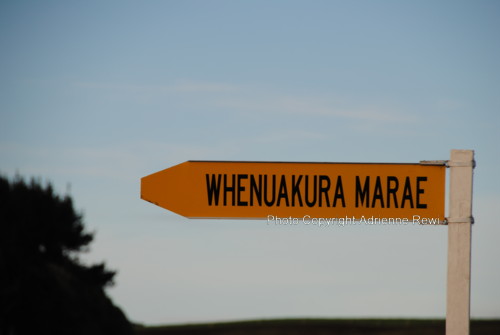
 I was driving from Whanganui to New Plymouth last June when I saw a sign at Waitotara (north of Whanganui), pointing to Wairepa Marae, 5km away down a side road. It was early morning and the sun was just coming up, throwing a cautious glow across the tall, dried, maize fields. I ended up driving the full distance of the road and unless I missed a functioning marae down one of the other side roads, all I could find was a derelict little settlement around this war memorial.
 There were a few abandoned houses nearby, a few cows, twittering finces and a few plovers. Nothing else. And as I sat there, I thought how sad the whole business seemed. I'm sure surviving members of Willie Karipa's family haven't forgotten him but it did seem a shame that his lichen-covered memorial now sits, shabby and alone in 'the middle of nowhere.' A bit of quick research has found mention of Willie Karipa at the National Army Museum in Waiouru. He's mentioned on the Tears of Greenstone Memorial there. He was just 23 and a member of the 28th Maori Battalion, when he was killed in action in the Western Desert in 1942.
 I photographed this wonderfully whimsical dress - made of plastic tiki - at last year's Ngai Tahu Huia-a-Tau, which was held at Puketeraki Marae at karitane, North of Dunedin. It was made by clothing designer, Amber Bridgman (Ngai Tahu, Kati Mamoe, Waitaha, Rabuwai) for her entry into a national art-fashion award. Amber, who also designs her own range of jewellery, was last year invoted to present a collection of her garments at the prestigious New Zealand Fashion Week, after winning the tee-shirt design section of Miromoda, an annual Australasian fashion design competition based in Wellington. She produces and sells her garments under the label Kahuwai - garments inspired by traditional Maori designs and geared to babies, toddlers, all the way through to adults. www.kahuwai.co.nz
  Two Kete