Main Highway, Turakina
Near Whanganui
North Island
May 2010, Ajr


 Ohinemutu Maori Village on Rotorua's steaming lakefront, is one of my favourite places. I love wandering about the skinny streets, watching natural geothermal steaqm hissing up through gardens and gutters, the mud bubbling in nearby pools, the marae and the magnificent St Faith's Church. In among it all is this cute-as-a-button carved whare (house). I've always assumed it was part of one of the marae but on a recent visit, talking with one of the locals, they told me it is a private house that has been lovingly restored with a carved front and that someone does in fact live in it. It's such a lovely visual surprise, snuggled there among all the modern Western-stye housing. Wouldn't it be nice if more modern Maori considered doing this? How much more interesting our modern streets would look.
 The Rotorua Farmers' Market at Kuirau Park in Rotorua is somehow 'quintessential Rotorua.' Get down there early on a Saturday morning (in winter in this case) and the geothermal mist is rising, the smell of sulphur hangs in the air and an early guitar is strumming a few warm-up chords.
 It's not a Maori market per se, but you'll find a wide range of traditional Maori kai favourites - puha, Rewena bread, steamed puddings, fresh kina, whitebait fritters, mussel patties and watercress bundled into big leafy bunches.
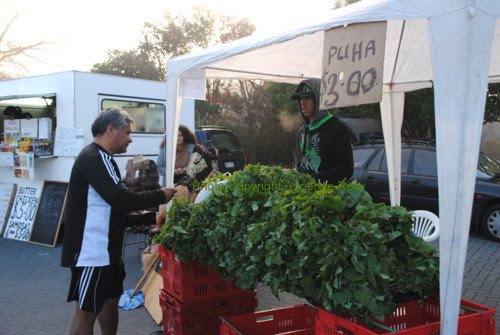 There are stalls selling Maori handcrafts (and a few imitations) and on the morning I went, back in June, there was a woman making korowai (cloaks), her fingers seemingly impervious to the cold as she wove feathers into her garment. The market has a wide range of fresh vegetables and a great atmosphere - definitely a must-visit if you're in town on a Saturday morning.
 As I left Whanganui recently, driving northwest to New Plymouth on the Surf Highway, I came upon this unusually picket-fenced marae down a side road. It's Waiokura Marae, located on Winks Road, just south of the small town of Manaia, which was settled in the 1880s and named after Chief Manaia Hukunui. The whare here - Paraukau - was built in his honour. It's home to the people of Ngati Tu, a hapu of Nga Ruahine. All was quiet the morning I arrived - but for the early chattering and tinkering at the nearby Kohaga Reo - a peaceful scene, with the metal road snaking away into the rolling green and Mt Taranaki looming protectively on the horizon.

 It was a different story a short distance away on the main highway opposite the Manaia Golf Course, where these signs indicate Ngati Tu dissatisfaction over their unresolved land claims.
 Back in May, when I was edging my way north from Wellington, I was determined to stop at least one of the sign-posted marae. I had been unable to last year because of the large traffic volumes and my own time constraints. So this time, when I saw the sign pointing to Kikopiri Marae at the little Horowhenua settlement of Ohau, I turned off the highway and followed a narrow country road for a few kilometres.

 It was a drizzly but sunny day and the short road leading to the marae on a small hill was muddy so I didn't even get out of the car. But I was taken with the prettiness of the scene - the little old marae peeping out from behind giant harakeke (flax) and what looked to be small kauri or totara trees. I haven't been able to find out a lot about the marae but it does appear to be an important centre for Ngati Kikopiri people and I was able to trace some lovely old photographs in Alexander Turnbull Library files, showing the marae between 1895-1906 - recognisable by the building's distinctive carved amo (the upright carvings on the front gable). According to my other readings, I think there may be a connection to Ngati Raukawa - some of whom migrated to Horowhenua in the early 1820s, to this area....though I can't be sure of that and am open to reader suggestions. www.kikopiri.whanau.org.nz
 The day I left Tauranga in the Bay of Plenty on my recent travels around New Zealand, I took my time, dawdling first in the lovely, little seaside village of Maketu before carrying on to sunny Te Puke.

 I was so distracted by my thoughts about Maketu - and how much I loved the place - that as I drove out of Te Puke I almost missed this marae - Tuhourangi Marae. If it hasn't been for the bright school gateway on this Te Kura Kaupapa Maori, I would have sailed straight past.
 I love walking a city and unexpectedly coming upon a work of public art.
 A few days later, I happened upon this second dramatic piece by Graham, Kaitiaki .
 Back in May, when I was travelling up the North Island, I saw a monument on the side of the road (below), just south of Otorohanga in the South Waikato/Waitomo area. I spun around and pulled into the side parking area to see what it was all about.
 That's when I saw the yellow road sign marking Rereamanu Marae.

 It was here - at Rereamanu Marae, on February 5, 2009, that Ngati Maniapoto hosted tribes from all over New Zealand - and Te Arikinui, King Tuheitia, to mark and celebrate 150 years of the Kingitanga Movement. The 3-day event was hosted here at Rereamanu because it is the closest site to where Chief Potatau Te Wherowhero was confirmed as Maniapoto's choice to become the first Maori King. Potatau was subsequently crowned the first Maori King in Ngaruawahia in April, 1858. The memorial above marks the site of the first meeting of those chiefly discussions and chronicles the history.
 One Man
 " Rei matua, hei taonga e mau noa ana ki te tane/wahine ranei.
 I love the new entrance to Waitomo Glowworm Caves and I was fascinated on a recent visit by the pouwhenua decorating the forecourt. I've never seen Maori carving like this before - not incorporating flowers and birds at least. It seems a quirky departure from tradition.

 Te Poupou a Tane Mahuta was unveiled on December 28, 1987 by Robert W Stannard CMG and Claude Taane to commemorate the centennial of the first exploration of the Waitomo Caves.

 The carving depicts Tane Mahuta, God of the Forest, guarding the entrance to the caves and their inhabitants below. The Chief Carver was Tutunui Te Kanawa helped by around a dozen others. It's a magnificent entry statement that draws a lot of attention. When I visited a bus load of Japanese were all taking each other's photographs in front of it.