Wednesday, October 13, 2010

Art at the Civic Centre


Given earthquakes and book writing, I have only just managed to get myself along to the new Christchurch City Council Building - a joint venture between the council and Ngai Tahu - and I must say I am impressed. Who would have thought the old New Zealand Post building would 'scrub up' so nicely. What I particularly like is the building's 'twin face' - the Worcester entrance above, with its wonderful Fayne Robinson powhenua, Te Pou Herenga Waka; and the southern Hereford Street entrance (below), which features the magnificent etched glass mural by Ross Hemera, Tuhituhi Whenua.

Given that the building is a joint venture, a bicultural undertaking as it were, it is also fitting that two other major artworks by leading Pakeha artists are featured - Neil Dawson's Ripple and Feather, which I never actually saw; and the above work, Knot, by Julia Morison. The latter is typical of Christchurch-based Morison's sleek, complex, beautiful perfection - a work that shimmers and changes as you move through the building from one side to the other. It is partially marred here by the scaffolding supporting a large section of inner structure that was damaged in the recent Christchurch earthquake. Based on an 'infinity knot' common in Celtic art, it alludes to the complexities and multiple pathways of communication, which seems entirely fitting for a bicultural public space.

The northern entrance to the building is dominated by the powhenua, carved by Fayne Robinson (Kai Tahu, Ngati Apa Ki Te Ra To, Ngati Porou), which is beautifully offset by the gently cascading water feature. It's there - among a series of decorative tiles representing seven of Canterbury's important waterways, that you'll find the bronze eels by Ngai Tahu artist, Priscilla Cowie (top image). Both water and eels were key determinants in the original settling of Canterbury land. The seven water tiles are mirrored by a further seven tiles on the rear of the powhenua that represent the site's history.

It's the intricate glass mural by Ross Hemera though that I found the most interesting. Hemera (Ngai Tahu, Mamoe, Waitaha), is currently an Associate Professor in the School of Visual and Material Culture at Massey University. 'His creative works draw inspiration from the South Island landscape and in particular the ancient rock drawings found in limestone caves and outcrops that were created by his tipuna (ancestors), the nomadic Waitaha. His works have been exhibited internationally and major commissions include the Wakamarama sculpture at the entrance to the the Maori section of Te Papa Tongarewa, and the beautiful glass windows throughout the interior of Te Runanga of Ngai Tahu, Te Waipounamu House in Christchurch.
His gigantic work for the Hereford Street face of the new Civic Building, is inspired by the words of Matiaha Tiramorehu's petition to Queen Victoria in 1857. In that, "it honours the wishes of Ngai Tuahuriri that these words serve as a aspiration of unity to recognise the partnership between Ngai Tahu and the Christchurch City Council. As it stretches across the wide face of the building, it 'weaves along braided rivers' and over the Canterbury Plains. Ti Kouka, the cabbage tree, has a starring role and willow trees allude to English settlers. All up, it's a stunning work that 'explores both the geological ancrestry of central Te Waipounamu (the South Island) and the material culture of the people' who settled here. More than anything though - more than the beauty of these individual artworks even - I am impressed by the 'recycling' of the old NZ Post building. It was never a high point of any inner city wander and while it could have been demolished and an all-new structure built (at huge cost), it's a credit to both parties that they sought what I think is the harder road - turning an architectural ugly duckling into a thing of beauty.

Sunday, October 10, 2010

The Meeting House

On a recent visit to Taupo, I called into the Taupo Museum where I was most impressed by the display of this beautiful carved wharenui (meeting house). It's named Te Araha Rongoheikumi. If you remove your shoes you can enter - but not with a camera of course - so you'll just have to believe me when I say it was beautifully lit on the inside, to show off the incredible carving detail. There's a hint of that in the blue light washing up behind the wharenui in the main entrance hall. I love the addition of the burgundy leather sofa to the mahau (front porch). For any international readers not familiar with Maori architecture and culture, the wharenui was traditionally, the central building of a Maori village and now, of a marae. It literally means "big house" and depending on its use, it can also be known as the wharehui, whare tipuna or whare wananga. The wharenui is where a tribe records its history in carving, painting and weaving; it is a building that symbolises and important tipuna (ancestor) and major parts of the building represent parts of the ancestor's body. The amo for instance - the two major vertical carved poles at the front of the building - represent the legs of the ancestor, standing firm on the land.

Wednesday, October 6, 2010

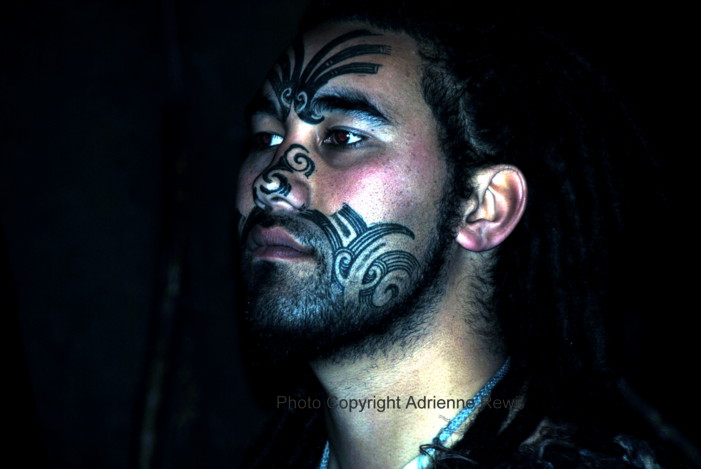
A Portrait - 23

A Performer
Tamaki Maori Village
Rotorua
June 2010, Ajr

Thursday, September 30, 2010

A Visual Moment

Right Place, Right Time.
A reflection of a waka - on a poster - caught in the moody waters of Lake Rotorua.
It almost looks real.

Tuesday, September 28, 2010

Maori Place Names - 74

Otakau Marae
Moeraki, Otago
South Island
May 2010. Ajr.

Wednesday, September 22, 2010

Tools of Navigation


It was a grey winter day when I visited the grounds of Parliament in Wellington earlier this year but that only accentuated the wonderful contrast between the bright green grass and this marvellous sculpture, "Kaiwhakatere - The Navigator" by Maori artist, Brett Graham.


Graham is one of New Zealand's most exciting sculptors, well known for his ability to engage in a "dual dialogue of Maori and European histories, at the same time adhering to the Modernist emphasis on form and material quality." Although not overtly Maori in their sculptural traditions, his works invariably draw on ancestral traditions and philosophies.


Although this work was only presented to the city in 2000, there's a lovely sense of the ancient about it - all those tightly packed granite cobblestones carrying the secrets and messages of another time. It's as if visitors from another world have left a strange and provoking souvenir of their visit among the shiny modern highrise.
The sculptures are based on the traditional tools of navigation - "Throughout Polynesia, the navigator is exalted as pathfinder and innovator for visionary qualities necessary for discerning leadershop," says Graham. The granite shapes represent a bird's head (manu), a waka (canoe) and a tuahu (altar). "The bird's head guides the traveller. It is a symbol of our inheritance in this land and of the future and the paths we may follow. The waka, or crescent moon shape symbolises a hopeful new beginning. The canoe suggests embarking on a journey, as did our ancestors, Maori and Pakeha. The tuahu, an altar of stones, built on arrival in a new land, suggests promises and challenges." (www.sculpture.org.nz)
Although stunning in its own right, I think the placement of this work is a major contributor to its power. It straddles the bright green hillocks of the parliament grounds confidently - like some ancient reminder to those in the 'halls of power' that soar above it, those 'navigating our future', that we are never far from our past.... no matter how much we would like to pretend otherwise.

Thursday, September 16, 2010

From the Kete Files

A Quiet Corner
Weaving Studio
Takahanga Marae
Kaikoura
Feb.2010. Ajr

Sunday, September 12, 2010

A Portrait - 22

Kapa Haka Performer
@ Te Puia
Rotorua
May 2009. Ajr

Thursday, September 9, 2010

Distracted by an Earthquake

To regular readers of this blog, I would like to apologise for the sudden 'halt to proceedings.' Along with the fact that I am writing a travel guide and don't have a lot of time for blogging if I am to meet my deadline, Christchurch was hit with a major 7.1 earthquake on Saturday, September 4 and we are still reeling under the pounding of continual after-shocks. Today, six days after the event, well over 120 after-shocks have been reported and everyone is living life on edge. But I promise I will be back with much more interesting things in the coming weeks. I have a wealth of photographs from my recent North Island trip and I'm looking forward to sharing them with you.

Wednesday, September 1, 2010

A Decorated Back Alley


A Mythical Creature
Of Maori Legend
And Imagination
Striding the Wall
Whanganui Back Alley
May 2010.Ajr

Monday, August 30, 2010

Maori Place Names - 73

Main Highway, Turakina
Near Whanganui
North Island
May 2010, Ajr

Wednesday, August 25, 2010

Village Whare


Ohinemutu Maori Village on Rotorua's steaming lakefront, is one of my favourite places. I love wandering about the skinny streets, watching natural geothermal steaqm hissing up through gardens and gutters, the mud bubbling in nearby pools, the marae and the magnificent St Faith's Church. In among it all is this cute-as-a-button carved whare (house). I've always assumed it was part of one of the marae but on a recent visit, talking with one of the locals, they told me it is a private house that has been lovingly restored with a carved front and that someone does in fact live in it. It's such a lovely visual surprise, snuggled there among all the modern Western-stye housing. Wouldn't it be nice if more modern Maori considered doing this? How much more interesting our modern streets would look.

Friday, August 20, 2010

A Portrait - 21

Tamaki Maori Village
Rotorua
June 2010, Ajr

Tuesday, August 17, 2010

Spuds!


Maori Potatoes
On Sale
Taupo Market
June 2010. Ajr

Friday, August 13, 2010

To Market, To Market


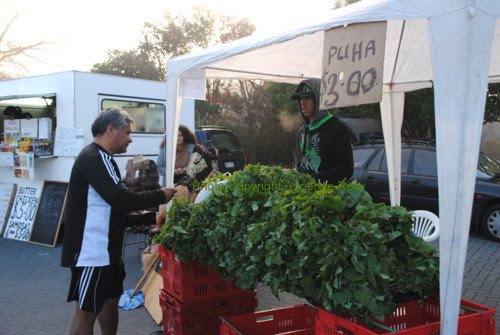
The Rotorua Farmers' Market at Kuirau Park in Rotorua is somehow 'quintessential Rotorua.' Get down there early on a Saturday morning (in winter in this case) and the geothermal mist is rising, the smell of sulphur hangs in the air and an early guitar is strumming a few warm-up chords.

It's not a Maori market per se, but you'll find a wide range of traditional Maori kai favourites - puha, Rewena bread, steamed puddings, fresh kina, whitebait fritters, mussel patties and watercress bundled into big leafy bunches.

There are stalls selling Maori handcrafts (and a few imitations) and on the morning I went, back in June, there was a woman making korowai (cloaks), her fingers seemingly impervious to the cold as she wove feathers into her garment. The market has a wide range of fresh vegetables and a great atmosphere - definitely a must-visit if you're in town on a Saturday morning.

Monday, August 9, 2010

Entering Taranaki


As I left Whanganui recently, driving northwest to New Plymouth on the Surf Highway, I came upon this unusually picket-fenced marae down a side road. It's Waiokura Marae, located on Winks Road, just south of the small town of Manaia, which was settled in the 1880s and named after Chief Manaia Hukunui. The whare here - Paraukau - was built in his honour. It's home to the people of Ngati Tu, a hapu of Nga Ruahine. All was quiet the morning I arrived - but for the early chattering and tinkering at the nearby Kohaga Reo - a peaceful scene, with the metal road snaking away into the rolling green and Mt Taranaki looming protectively on the horizon.


It was a different story a short distance away on the main highway opposite the Manaia Golf Course, where these signs indicate Ngati Tu dissatisfaction over their unresolved land claims.
www.ngaruahine.iwi.nz

Saturday, August 7, 2010

A Portrait - 20

Young Girl in the Sand
Kaikoura
Feb 2010. Ajr

Friday, August 6, 2010

Maori Place Names - 72

Moeraki, South of Oamaru
South Island
May 2010, Ajr

Thursday, August 5, 2010

Exploring the Horowhenua


Back in May, when I was edging my way north from Wellington, I was determined to stop at least one of the sign-posted marae. I had been unable to last year because of the large traffic volumes and my own time constraints. So this time, when I saw the sign pointing to Kikopiri Marae at the little Horowhenua settlement of Ohau, I turned off the highway and followed a narrow country road for a few kilometres.


It was a drizzly but sunny day and the short road leading to the marae on a small hill was muddy so I didn't even get out of the car. But I was taken with the prettiness of the scene - the little old marae peeping out from behind giant harakeke (flax) and what looked to be small kauri or totara trees. I haven't been able to find out a lot about the marae but it does appear to be an important centre for Ngati Kikopiri people and I was able to trace some lovely old photographs in Alexander Turnbull Library files, showing the marae between 1895-1906 - recognisable by the building's distinctive carved amo (the upright carvings on the front gable). According to my other readings, I think there may be a connection to Ngati Raukawa - some of whom migrated to Horowhenua in the early 1820s, to this area....though I can't be sure of that and am open to reader suggestions. www.kikopiri.whanau.org.nz

Monday, August 2, 2010

A Bay of Plenty Discovery


The day I left Tauranga in the Bay of Plenty on my recent travels around New Zealand, I took my time, dawdling first in the lovely, little seaside village of Maketu before carrying on to sunny Te Puke.


I was so distracted by my thoughts about Maketu - and how much I loved the place - that as I drove out of Te Puke I almost missed this marae - Tuhourangi Marae. If it hasn't been for the bright school gateway on this Te Kura Kaupapa Maori, I would have sailed straight past.
The gate is a memorial, unveiled in 1948, to Maori soldiers killed in battle. It was when I was walking back to my car after photographing the gate that I looked up and saw the marae in straight in front of me across the busy highway. I took these shots from there. I haven't hadd time to find out anything about the marae, other than it sits in the Rohe of Waiariki/Te Arawa. If any readers can enlighten me further please leave a comment.

LinkWithin

Blog Widget by LinkWithin